Turner & Constable: Rivals & Originals | Tate Britain
This large exhibition lightly remixes the Tate’s vast holdings of both artists’ works. But it feels churlish to complain about that, given the importance of these holdings.
Everyone will have a preference between these two giants of British landscape painting, and Constable’s my favourite of the two - a view shared by both Bridget Riley and George Shaw, according to a film accompanying the show! So it was a thrill to see a couple of important Constable loans from American collections, supplementing the Tate-owned works: The White Horse from the Frick in New York and Stoke-by-Nayland, visiting from Chicago.
The artists knew each other well, as frenemies. They frequently did battle at the Royal Academy’s annual exhibition, with spectacular large works placed close to each other. A review in Englishman’s Magazine for the 1831 show paid tribute to “Turner’s fire and Constable’s rain”.
These contrasting characteristics appear in their works again and again. Turner’s imagination so often turned to the semi-abstract celestial play of sunlight and firelight. Meanwhile, Constable was always grounded in the mulchy soil, dark branches and low light of his native land.
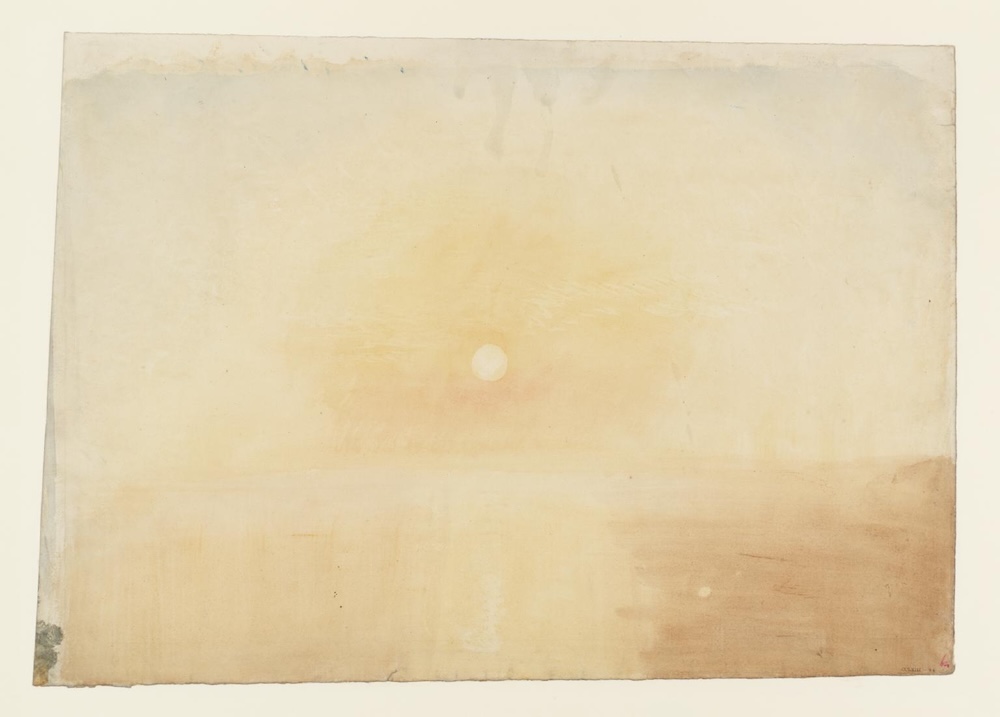 JMW Turner, ‘The Sun Rising over Water’ (c. 1825-30)
We can see this in the large canvases prepared for the RA. It’s there in smaller works, too. During my visit, I focused on a pair of sketches: one from each artist. Turner’s luminous, uninhibited watercolour sketch of the sun (pictured above) is tiny, dashed off, a genius gesture. The single point of light in the middle seems like a focal point to introspection.
While Turner conceived and executed these imaginative scenes in his studio, Constable worked outside. In the early 1820s he liked to sketch clouds. He tended to record the time of day on the back of the sketches, and the weather.
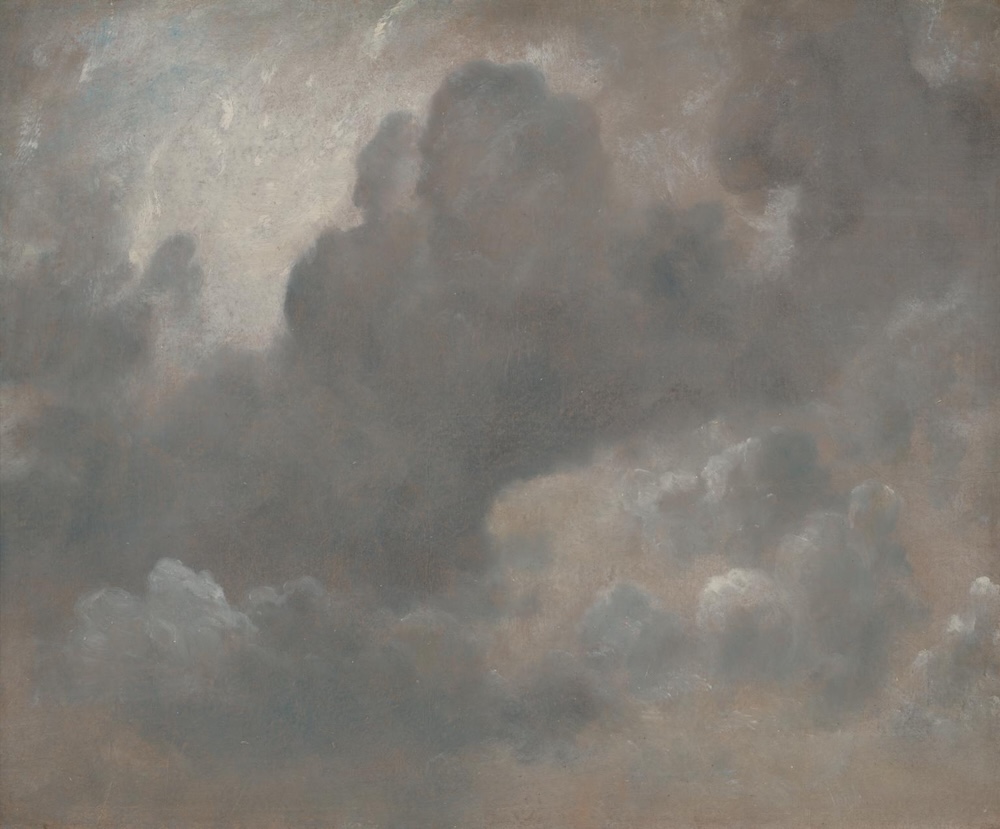 John Constable, ‘Cloud Study’ (1822)
I sat on a bench for a long time, looking at the study pictured above. The Tate’s archive tells us this one was inscribed by the artist in pencil on the original backing paper, now separately preserved: ‘27 augt 11, o clock Noon looking Eastward large silvery [? Clouds] wind Gentle at S. West’.’
What mystery and style is contained on the other side of that paper. Despite the stiff competition, I’m still with Bridget and George.
Turner & Constable: Rivals & Originals is at Tate Britain (London). 27 November 2025 - 12 April 2026